
Custom Bathroom Wallpaper Installation in Montreal
Bathroom Wallpaper Installation That Resists Moisture
Stop moisture damage before it starts.
Get a precision plan for bathroom or powder-room wallpaper that lasts.
Transforms small bathrooms quickly with bold patterns.
Resists humidity and cleans easily for longevity.
Delivers instant style without costly demolition work.


Why bathroom wallpaper requires a different playbook
High humidity, rapid temperature changes, and tight clearances challenge adhesives and seams.
A standard “living-room install” approach fails here. Our consultation treats your bathroom as a micro‑environment: we assess ventilation, substrate, splash zones, and cleaning cycles, then specify materials and methods that resist moisture and mildew while preserving design intent.

How To Start Your Bathroom Wallpaper Instalation
Site & substrate assessment – humidity mapping, ventilation check, paint/gypsum condition, and primer compatibility.
Material specification – selection guidance across vinyl (Type II commercial-grade), fiberglass-reinforced, washable non‑woven, and acrylic‑coated papers; cleanability and scrub ratings.
Adhesive & primer plan – mildew‑resistant pastes, sealing primers, and where to use seam sealer vs. clear silicone in wet-adjacent edges.
Layout & seam strategy – pattern placement for small rooms, seam locations away from splash zones, and trim/cap details at vanities, mirrors, and tile stops.
Risk register – identifies shower‑adjacent limits, condensation hotspots, and mitigation options (paneling/backsplash transitions, exhaust upgrades).
Budget & timeline – realistic scope, prep days vs. install days, and maintenance guidance.
- Fewer callbacks
- Longer service life
- A clean finish that survives daily use.
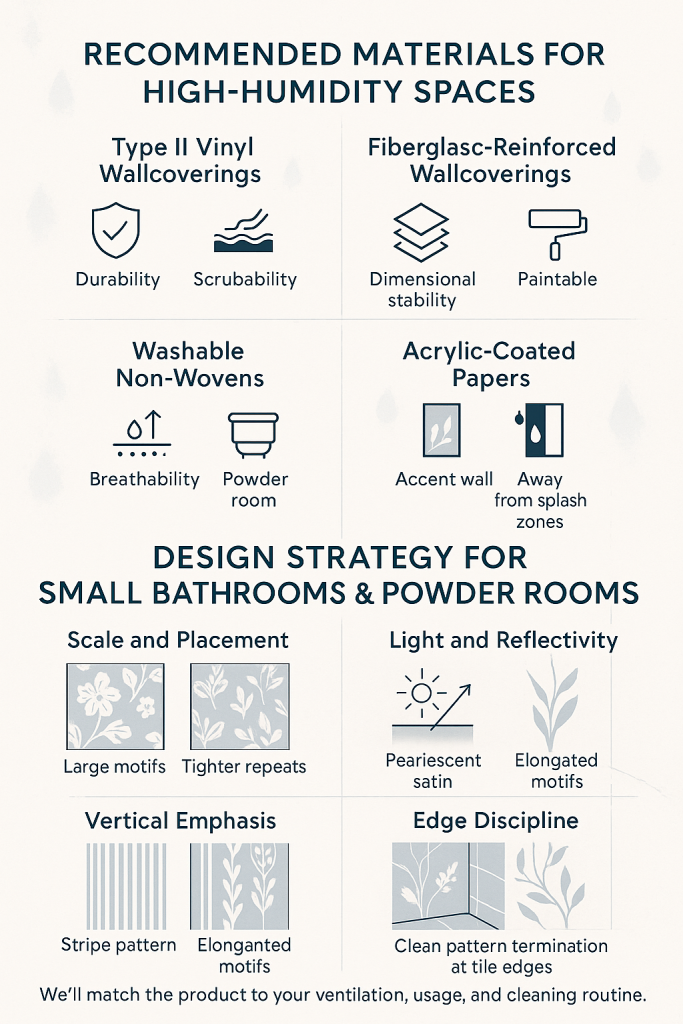
Recommended materials for high‑humidity spaces
Type II vinyl wallcoverings – durable, scrubbable, ideal for family bathrooms.
Fiberglass‑reinforced wallcoverings – dimensional stability, paintable finishes, high impact resistance.
Washable non‑wovens – breathable with proper priming; good for powder rooms with intermittent humidity.
Acrylic‑coated papers – for accent walls outside direct splash zones.
We’ll match the product to your ventilation, usage, and cleaning routine.
Design strategy for small bathrooms & powder rooms
Scale and placement: large motifs on a single uninterrupted wall; tighter repeats on all four walls to avoid awkward cuts.
Light and reflectivity: pearlescent or satin sheens to bounce light without showing every imperfection.
Vertical emphasis: stripe or elongated motifs to add height; wrap short walls to visually widen niches.
Edge discipline: terminate patterns cleanly at tile edges, surrounds, and built‑ins.
Our installation process
Prep & prime – de‑gloss, skim where needed, seal with a moisture‑appropriate primer.
Cut & hang with humidity in mind – staggered seams, rolled pressure at edges, targeted seam sealing.
Finish & cure – controlled dry‑down, edge protection near sinks and backsplashes, maintenance briefing.
FAQs
Is wallpaper “waterproof”?
No wallcovering is fully waterproof; the system (substrate, primer, adhesive, seams, and edge details) manages moisture.
We specify products for high humidity and locate seams away from splash zones.
Can I wallpaper inside a shower?
There are specialty products designed for shower areas. These materials can also be custom printed with your own design.
How long will it last?
With correct materials and ventilation, bathroom installations routinely last 7–10+ years with proper care.
DIY vs. professional?
Bathrooms punish minor mistakes. Professional prep, seam planning, and edge sealing prevent early failure.
What prep is required?
Sound dry walls are essential: fill, sand, de-gloss, and prime with a moisture-appropriate sealer; we reject compromised substrates before install.
How do I clean bathroom wallpaper?
Use a damp microfiber cloth with mild soap; avoid abrasives and saturating seams.
Type II vinyls permit gentle scrubbing per manufacturer rating.
Do I need better ventilation first?
If RH regularly exceeds ~60% after showers, we recommend upgrading exhaust or run-time; proper ventilation prolongs adhesive and seam performance.
Can it be removed later without damage?
Yes—quality primers and non-woven backings allow controlled strip or peel. Steam/gel aids removal; we restore walls for repaint or re-papering.