

Small spaces present a unique design challenge, but they also offer an incredible opportunity for creativity. With the right strategy, a compact room can transition from feeling cramped to becoming a “jewel box” of chic design.
Finding the best wallpaper for a limited floor plan doesn’t have to be a struggle; it’s about choosing a papier peint that speaks to your specific architectural layout. So whether you are decorating a historic Plateau duplex or a modern Griffintown condo, our Montreal wallpaper store offers curated collections designed to open up every corner.
In this guide, we explore how to use wallpaper to create the illusion of space, add depth, and bring high-end personality to any Montreal condo or apartment.
A small space is defined by a few caracteristics:
- The space does not have any windows or is closed off without natural light
- The room does not have high ceilings with extended wall space.
- There are few bare wall surfaces in the roo

Debunking Top Design Myths:
Why Large-Scale Patterns Work in Small Spaces
For decades, conventional wisdom suggested that small rooms require small patterns. In 2026, interior designers have turned this on its head. Maximalism, murals, even panoramic wallpaper, all have their role to play in creating the best designed small space in your home.
In the case of large patterns, the essential narrative is pattern repeat and wall size. If the dynamic of the paper allows for a large image narrative to be displayed, for example, a jungle wallpaper with animals and botanicals, so long as the pattern can be expressed more than once your effect can be gorgeous.
Ironically, large-scale patterns can actually make a room feel more dynamic and spacious despite these conditions. A bold design draws the eye upward, creating an illusion of height. A large image print or potentially even a panoramic mural in some cases, can tell a vivid story in a small area. Take the example of Tres Tintas panoramic and patterned collections. Albeit being larger images, they allow for custom resizing , allowing for the images to be cropped to your required scale. The key is to look for patterns with significant “negative space” (a light-colored background) to prevent the room from feeling claustrophobic.
Best Panoramic Wallpaper for Small Spaces: Tres Tintas

Design Expert Summary:
The common “rule” that small rooms require small patterns is a fundamental misunderstanding of visual volume.
In reality, the success of a design depends on the relationship between the pattern’s repeat, its line weight, and the direction of the room’s bare surfaces.
The Architecture of Pattern
The Power of Over-Scaling: Camouflaging Boundaries
Large-scale florals and oversized botanicals are often the most effective tools for making a room feel expansive. When a pattern is “over-scaled”, meaning the motif is larger than the viewer expects, it breaks the visual boundaries of the wall.
The Design Logic: In a small powder room or entryway, a large-scale design (like a Sanderson mural) removes the “grid” that the eye uses to measure distance. If you cannot see the full repeat of a pattern, the wall feels infinite.
Best For: Transitional spaces where you want to create a “portal” effect, drawing the visitor into a world of art rather than a cramped utility room.
Breaking the “Mental Yardstick”
The human brain is incredibly efficient at measuring space. When we walk into a room, we subconsciously look for repetitive markers, the height of the baseboard, the width of the door frame, or a tight wallpaper repeat, to calculate the room’s size.
Small Patterns = A Visible Grid: A small floral with a 5-inch repeat creates a “visual grid.” Your brain counts those repeats across the wall and says, “This wall is exactly 8 repeats wide; therefore, this room is tiny.”
Over-Scaling = Infinite Planes: When you use a motif where a single leaf or petal is 24 inches wide, you destroy that grid. If the eye cannot see where the pattern starts and ends within a single glance, the “mental yardstick” fails. The wall stops being a boundary and starts being a canvas.
The “Portal” Effect: Transitional Immersion
Transitional spaces like entryways or powder rooms are unique because we don’t “live” in them; we pass through them. This allows for a higher level of visual intensity.
Atmospheric Depth: A large-scale mural (like a Sanderson forest scene or a panoramic botanical) creates “Atmospheric Perspective.” Because the design is so large, it mimics the way we see the world outside. The wall effectively “drops away,” and your brain perceives the depth of the forest rather than the flatness of the drywall.
The Hero Motif: In a small room, an oversized pattern acts as a “Hero.” Instead of a hundred small distractions, you have one singular, high-impact design. This focus actually simplifies the visual field, making the room feel intentional and curated rather than cluttered.
High-Contrast vs. Low-Contrast Over-Scaling
Not all large-scale patterns behave the same way. The chromatic contrast determines how much “weight” the pattern has in the room.
High Contrast (e.g., Black & Gold): This will make the wall “advance” toward the viewer. In a powder room, this creates a dramatic, high-fashion “Jewel Box” where the walls feel like they are wrapping around you in a luxurious embrace.
Low Contrast (e.g., Tone-on-Tone Sage): This makes the wall “recede.” The large pattern is there, but it is felt more than seen. This is the ultimate secret for a small Montreal bedroom, it provides the architectural depth of a large pattern without the visual noise that prevents sleep.
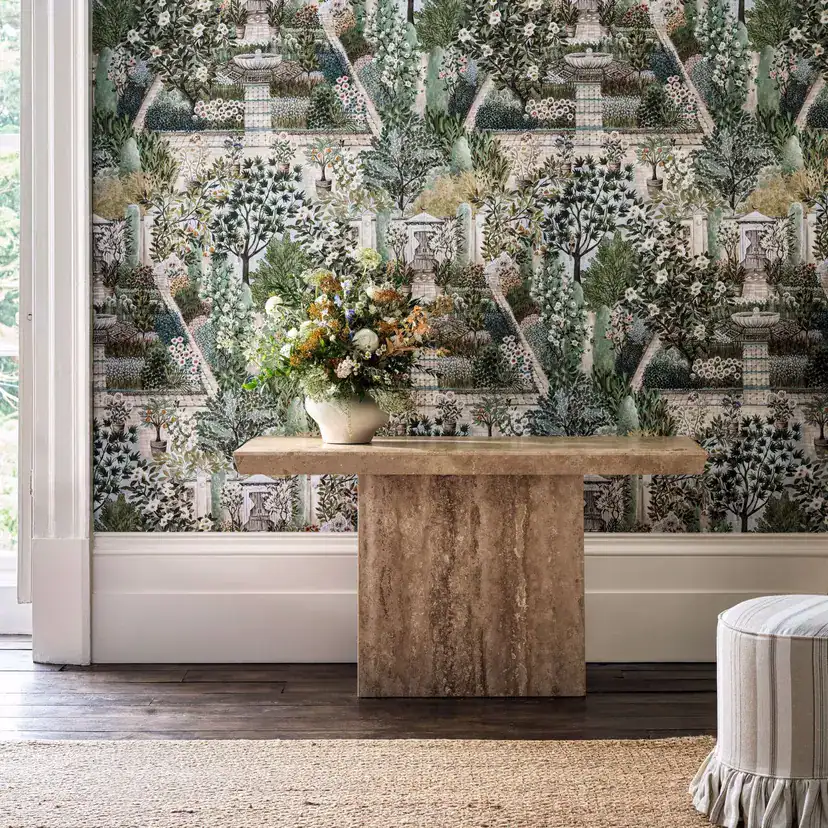
The "Benjamin Moore" Anchor: Balancing Bold Patterns with Paint
To make an oversized botanical truly “breathe,” you must anchor it with the right paint colors.
At Empire Wallpaper, we recommend the “Pull-Out” Method: identify the least dominant color within your mural, perhaps a muted sage or a soft taupe, and use that for your trim, baseboards, and doors.
Erasing the Boundaries: For a seamless “Infinity” effect, paint your ceiling in a Flat finish using a color that matches the background of your wallpaper. This trick “erases” the hard line where the wall meets the ceiling, making a small Montreal condo feel significantly taller.
The “Jewel Box” Trim: If you’ve chosen a high-contrast floral, don’t play it safe with white trim. Selecting a deep, moody Benjamin Moore shade that matches the darkest leaf in the pattern will create a sophisticated, “enveloped” feel perfect for a luxury powder room.

Avoiding the "Museum Trap": Furniture and Lighting
A common fear is that a large-scale pattern will “swallow” the furniture. In reality, an oversized design acts as a structural element rather than a mere decoration.
Scale Contrast: Pair your large botanicals with furniture that has clean, minimalist lines. A sleek mid-century sideboard or a simple glass table allows the “Hero Motif” of the wallpaper to remain the focus without creating visual clutter.
Layering with Intent: When hanging art or mirrors over a large-scale pattern, follow the Rule of Thirds. Choose a large, simple mirror that reflects the pattern from the opposite wall, effectively doubling the “depth” of your room.
Sculpting with Light: Use wall sconces to “graze” the surface of the wallpaper. This creates subtle shadows within the oversized petals or leaves, enhancing the 3D “Atmospheric Perspective” and making the wall feel like a living garden.
The "Horizontal Grid" vs. "Vertical Perception"
While oversized botanicals break the horizontal “grid,” we can further manipulate a compact room by addressing vertical perception, a key trend in the 2026 “Circus-core” movement.
Stretching the Wall: Pairing an oversized floral with a bold, wide-stripe companion on the ceiling or an adjacent wall creates a “tent” effect.
Heightened Perception: By using vertical stripes alongside your “Hero Motif,” you force the eye to travel upward, making low Montreal ceilings feel loft-like and expansive.
Vertical perception is the same trick, but for the height of the room:
In many Montreal apartments, ceilings are the limiting factor.
By adding vertical elements (like stripes or tall stalks in a botanical), you force the eye to look up and down.
The brain assumes the ceiling is higher than it actually is because it’s following a “long” line.
What is “Circus-core”? The 2026 Trend
This is a specific term Pinterest has identified as a major trend for 2026. It’s not about literal clowns; it’s about:
Bold stripes (like a circus tent).
High-contrast colors (reds, golds, deep blues).
Whimsical, oversized motifs.
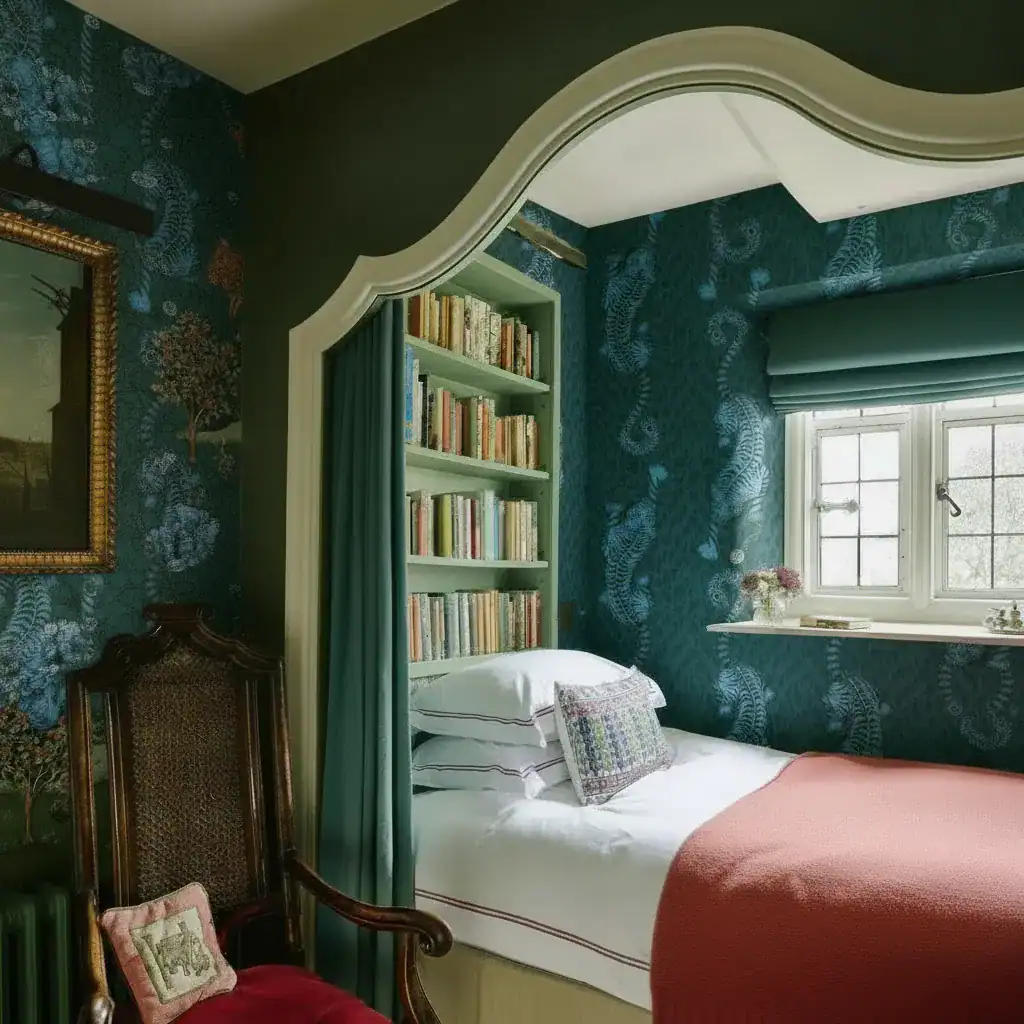
Beyond the Mural: Texture and the "Neo-Deco" Influence
To truly defeat the “Mental Yardstick,” the surface of the paper must offer more than just an image; it must offer tactile depth.
The “Neo-Deco” Finish: 2026 trends are leaning into metallic inlays and pearlescent inks. In a small powder room, these “glowing” elements catch the light, creating a secondary layer of depth that makes the walls feel like they are receding.
Sisal and Grasscloth: An over-scaled pattern printed on a textured grasscloth adds a physical dimension. This prevents the “flatness” of the drywall from re-establishing the room’s boundaries.

Share the Transformation (Pinterest)
If you found this breakdown of “Design Logic” helpful, pin the images below to your Montreal Home Reno or Small Space Design boards.
Ready to break the boundaries of your home?
Visit our Montreal boutique to see these oversized botanicals in person and consult with our experts on the perfect Benjamin Moore match for your project.